
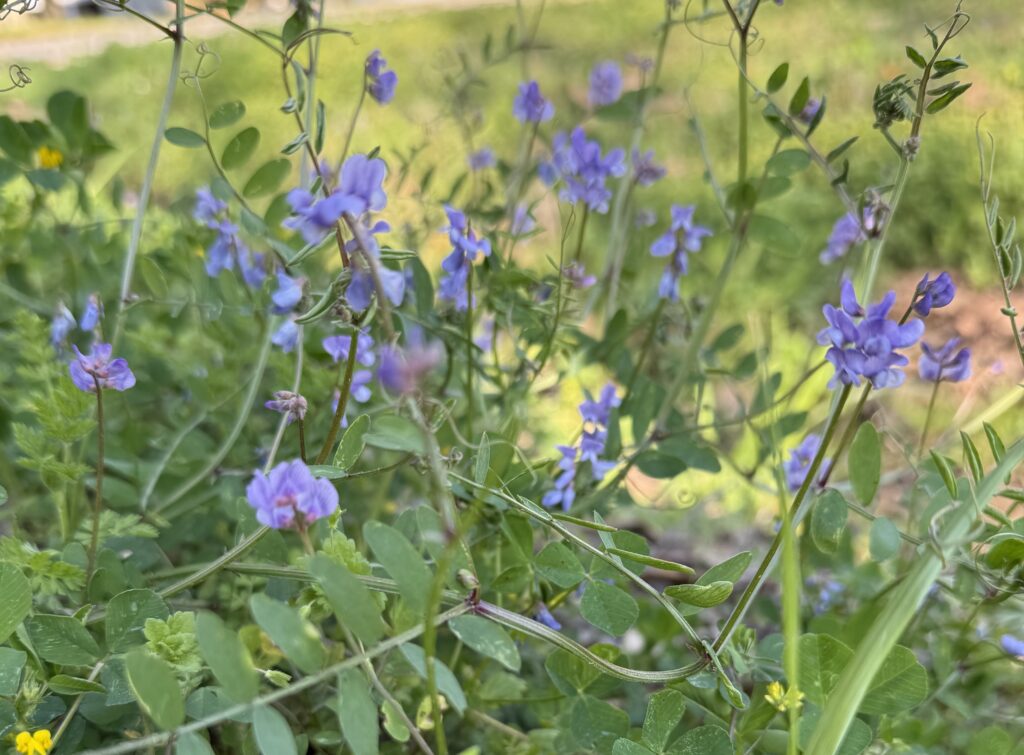
I love the world God created. It’s normal for me to stop to see a wildflower, which some people would call weeds, and take in its beauty. Like my Aunt Ginger, I’m drawn to natural light in all its forms but especially the sun – there’s nothing like the glow of a sunrise or the warmth of golden hour. Where I live we hear frogs, crickets, and the wind chimes on the porch. I breathe in the fresh country air, the smell of baking banana bread, or the sweet scent of my husband’s cologne.
I love good things. We all do. It’s part of being human, to be drawn to the good and beautiful and right.
What is this longing we all feel inside, for everything to be good? It’s the desire to be near to God. The longing to use our gifts and talents, the draw to beautiful things, the hunger for the world to be right again – all of these are directly connected to our desire to be near the One who made us.
Ecclesiastes 3:11 explains this: “He has made everything beautiful in its time. He has also set eternity in the human heart; yet no one can fathom what God has done from beginning to end.”
This is critical to understand. We have a longing for eternity without a complete understanding of God’s eternal plan, His working among humanity.
Scripture identifies God as “the Father of Heavenly Lights” and the giver of “every good and perfect gift (James 1:17). Every good thing we know and experience is a gift from Him. This can be a hard pill to swallow when we experience difficulty, brokenness, and strife.
However, I’ve learned to recognize that the beauty He gives includes gifts that come through pain and suffering. I’ve lived long enough to walk through hard things, and sometimes those hard things produce the sweetest gifts. Gifts like knowing Him better; a community surrounding you; and spiritual, emotional, mental growth and resilience.
I cannot overcommunicate the importance of that last one.
Our time here on earth is meant to be a balance of beauty and brokenness. We are called to take in God’s beauty, to learn more about Him – the Westminster Shorter Catechism calls us to “glorify God and enjoy Him forever” – and this happens in the present as well as into eternity. Whatever our circumstances, I believe God reveals Himself and His beauty to us.
However, there is also a call to brokenness echoed in the narratives of Scripture. With Abraham to Moses, Esther to Daniel in the Old Testament, and extending to Peter and Paul and the martyrs of Revelation in the New Testament, this call includes you and me.
This need for brokenness comes in many forms, and each of us is graced for the one we experience. I cannot imagine or even pretend to identify with the unique brokenness of every person; I can share the areas in my own life that require brokenness.
That journey has been a combination of mental health and ministry. I never expected to receive a mental health diagnosis, and yet I have seen God’s beauty throughout the entire process. I never expected ministry to be as hard as it was, but God’s beauty was evidenced throughout my ten years on church staff. All of it left me broken before “the One who sees me” (Gen. 16:13b).
Yet there is a sweetness in brokenness. In Luke 7 we encounter the sinful woman who anoints Christ:
“A woman in that town who lived a sinful life (we all, at our core, have lived a sinful life) learned that Jesus was eating at the Pharisee’s house, so she came there with an alabaster jar of perfume.As she stood behind him at his feet weeping, she began to wet his feet with her tears. Then she wiped them with her hair, kissed them and poured perfume on them.” Luke 7:37-38
It’s likely this jar would have been her dowry, all she had as financial security for her future. It’s also likely that it would have had to be broken to be used. She takes her best, breaks it, and pours it on Jesus’ feet.
This reckons to Psalm 51: “My sacrifice, O God, is a broken spirit; a broken and contrite heart you, God, will not despise.”
The Hebrew for “broken” is šāḇar, which means:
šāḇar: to break, break in pieces
- (Qal)
- break, break in or down, rend violently, wreck, crush, quench
- to break, rupture (fig)
- (Niphal)
- to be broken, be maimed, be crippled, be wrecked
- to be broken, be crushed (fig)
- (Piel) to shatter, break
- (Hiphil) to cause to break out, bring to the birth
- (Hophal) to be broken, be shattered
Jesus wants our best, but He also wants our brokenness. Often, these two are intertwined and inseparable.
The word for break used here can also be translated as “to break out, to bring to the birth.”
When my Mama was pregnant with my youngest sister, she experienced a great deal of nausea. After coming home from school I would climb up into her king-sized bed with my middle sister to eat ginger snaps and watch TLC’s birthing channel. Looking back, it’s wild to me that my mom wanted to watch videos of labor and delivery before giving birth – wasn’t that terrifying?! – and that I watched with her and enjoyed them! But to this day, I love a good birthing story.
Birth signifies new life. But if I learned anything from those TLC shows, it’s that birth requires pain. It requires a breaking out of something old and no longer needed (the womb) into something new and unexpected (the world).
God desires to birth something in you, friend. He desires to bring goodness out in you, but the sweetness of His goodness usually only comes at the cost of brokenness.
What does brokenness look like?
It looks like turning to God in your pain. It looks like trusting Him with your tears. It looks like surrendering your ways for His. It looks like leaning into wilderness seasons so God can work out of you what He is working into you.
When you do, He will continue to birth new things into you. Dreams, plans, hopes, desires. All of these, accompanied by your brokenness, point your heart to eternity and draw you closer to Him.

Leave a Reply